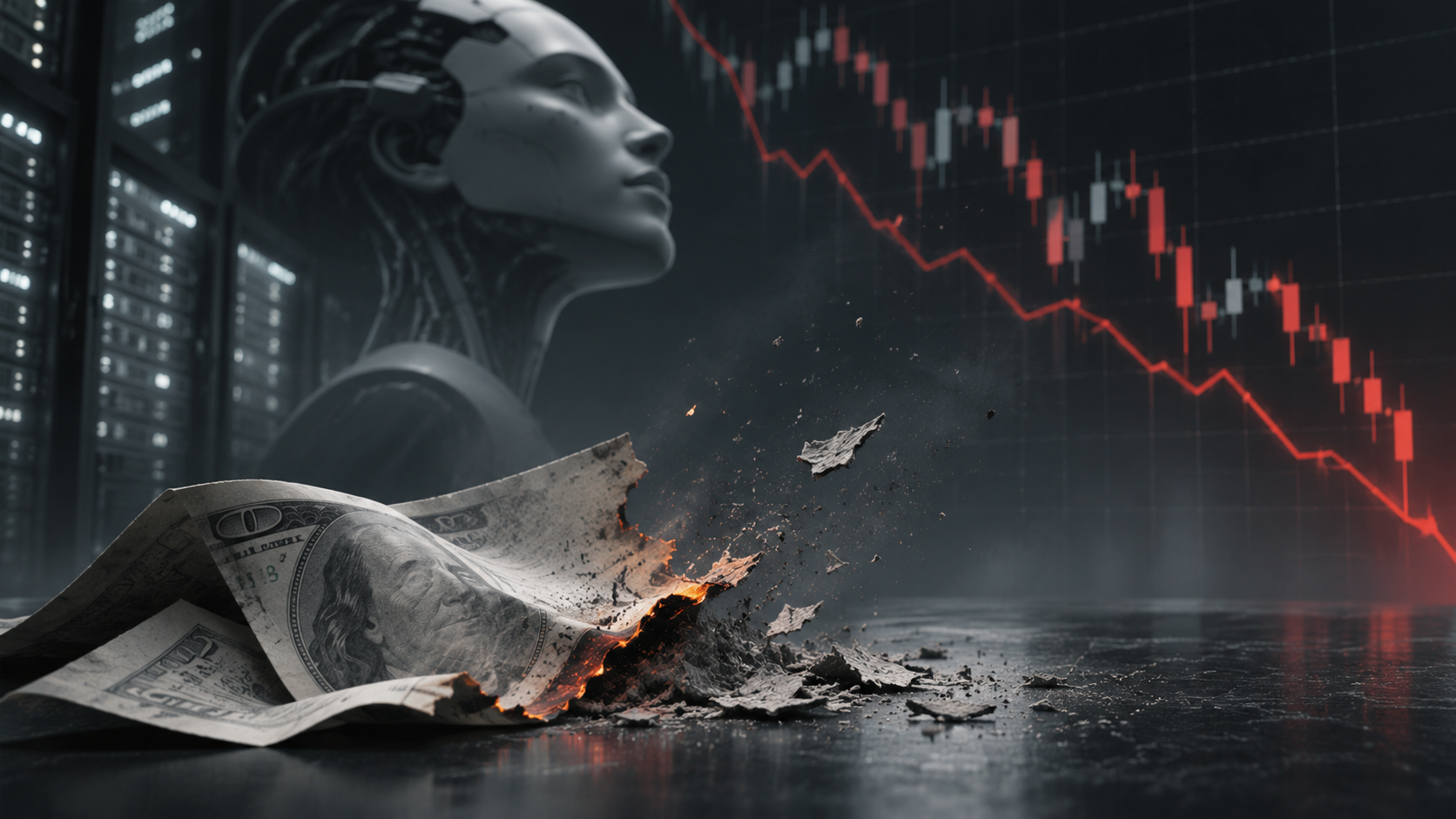
A dramatic illustration of Wall Street's technology stock selloff, featuring burning U.S. dollar bills, an artificial intelligence robot, and falling red stock market charts, symbolizing investor concerns over rising AI spending and declining tech valuations.
NEW YORK — A violent selloff in technology stocks wiped roughly $1 trillion in market capitalization from U.S. equities on Friday, as investors recoiled from evidence that the industry's massive artificial-intelligence spending spree is devouring cash without delivering commensurate returns.
The S&P 500 fell 1.82% to close at 7,580.07, its worst single day since June. The tech-heavy Nasdaq Composite plunged 2.86% to 25,437, while the Dow Jones Industrial Average dropped 572 points, or 1.09%, to 51,770.31. The damage was concentrated in semiconductors and hyperscalers: Intel suffered its worst one-day collapse since 1974, cratering nearly 29% after issuing a bleak forward outlook, while Nvidia fell 4.2% and AMD slumped almost 11%.
The AI Trade Hits a Wall of Cash Flow
The trigger for Friday's rout was a pair of earnings reports that crystallized a fear building for months: the biggest technology companies are pouring hundreds of billions into data centers and chips, but the cash generated by their core businesses is shrinking, not growing.
Amazon disclosed that it burned through $42.4 billion in free cash flow over the prior twelve months, spending $94.8 billion on property and equipment, primarily AI infrastructure. Alphabet, which suffered its worst one-day stock decline on record earlier in the week, reported negative free cash flow for a second consecutive quarter as capital expenditures surged. Meta and Amazon have similarly seen their free cash flow turn negative, while Microsoft's has declined.
"We're moving out of the hopes and dreams phase of the AI trade and into the 'show me' phase," Joe Tigay, portfolio manager at Equity Armor Investments, said in a note to investors.
The selling was not limited to equities. Gold tumbled below $3,900 an ounce, and bitcoin slid under $77,000 following a major hack at Binance that affected more than $6 billion in crypto assets. Treasury yields fell as investors sought safety, with the benchmark 10-year yield dropping to 4.945%.
Intel's Warning and Anthropic's Junk-Rated Future
Intel's collapse was the session's most dramatic single story. The chipmaker forecast fourth-quarter revenue of $15 billion to $16 billion, well below analyst expectations of roughly $17 billion, citing persistent weakness in the personal-computer market and $300 million in lost sales from a temporary factory closure in Israel. Chief Executive Lip-Bu Tan warned that PC industry weakness will persist through the first half of 2027, and Chief Financial Officer Dave Zinsner said heavy manufacturing outlays will prevent the company from generating free cash flow next year.
Separately, Blackstone warned investors that Anthropic—the AI startup preparing what is expected to be the largest IPO of the year—will likely carry a junk-bond credit rating even after going public. The assessment raises questions about how the company will finance its pledge to invest more than $800 billion in AI infrastructure by 2045, given that many insurers and pension funds face restrictions on holding sub-investment-grade debt.
A Market Searching for a Floor
The selloff capped a bruising month for technology shares. The Nasdaq has now fallen 7.8% from its record closing high on October 6, and the index shed more than 5.8% in October, with roughly $2 trillion in market value erased from the Nasdaq 100 during the month. The Philadelphia Semiconductor Index dropped more than 15% in October.
Yet the pain was not universal. Energy and consumer staples were the only S&P 500 sectors to post gains on Friday, rising 1.91% and 1.38% respectively, as investors rotated toward defensive names. Exxon Mobil and Chevron both hit all-time highs during the session and closed about 2% higher, buoyed by refining margins and rising oil prices.
The divergence reflects a broader sorting process that some analysts argue is healthy rather than catastrophic. Dan Ives of Yorkville Ives said it was not yet time to abandon AI-related stocks wholesale, but rather to distinguish between "disruptors (winners)" and "those being disrupted (losers)".
Truist Chief Investment Officer Keith Lerner put the challenge more bluntly: "The market is no longer simply asking whether AI demand is increasing. Wall Street is demanding tangible evidence that massive investments are translating into solid net income and cash flow".
What Comes Next
The market faces immediate tests. Tuesday's U.S. midterm elections could reshape the regulatory environment for data-center construction, with Democrats favored to win the House and potentially impose stricter environmental and energy reviews on AI infrastructure projects. Friday's October nonfarm payrolls report is expected to show 55,000 jobs added, up from 29,000 in September. And more than 130 S&P 500 companies report earnings next week, including Apple, AMD, and Palantir.
The Federal Reserve, which held rates steady at 3.75%–4.00% last week, has signaled that further tightening remains on the table. Market pricing currently assigns a 76% probability to a 25-basis-point hike at the December meeting. Fed Chair Kevin Warsh acknowledged that higher rates are beginning to bite in credit markets, noting that "market participants are becoming somewhat more discerning in their capital allocations".
For now, the AI trade—which powered the market to repeated records over the past two years—is undergoing its first sustained stress test. Whether Friday's trillion-dollar wipeout marks a necessary correction or the beginning of a deeper unwind may depend on whether the coming week's earnings and economic data offer the "show me" evidence investors now demand.