
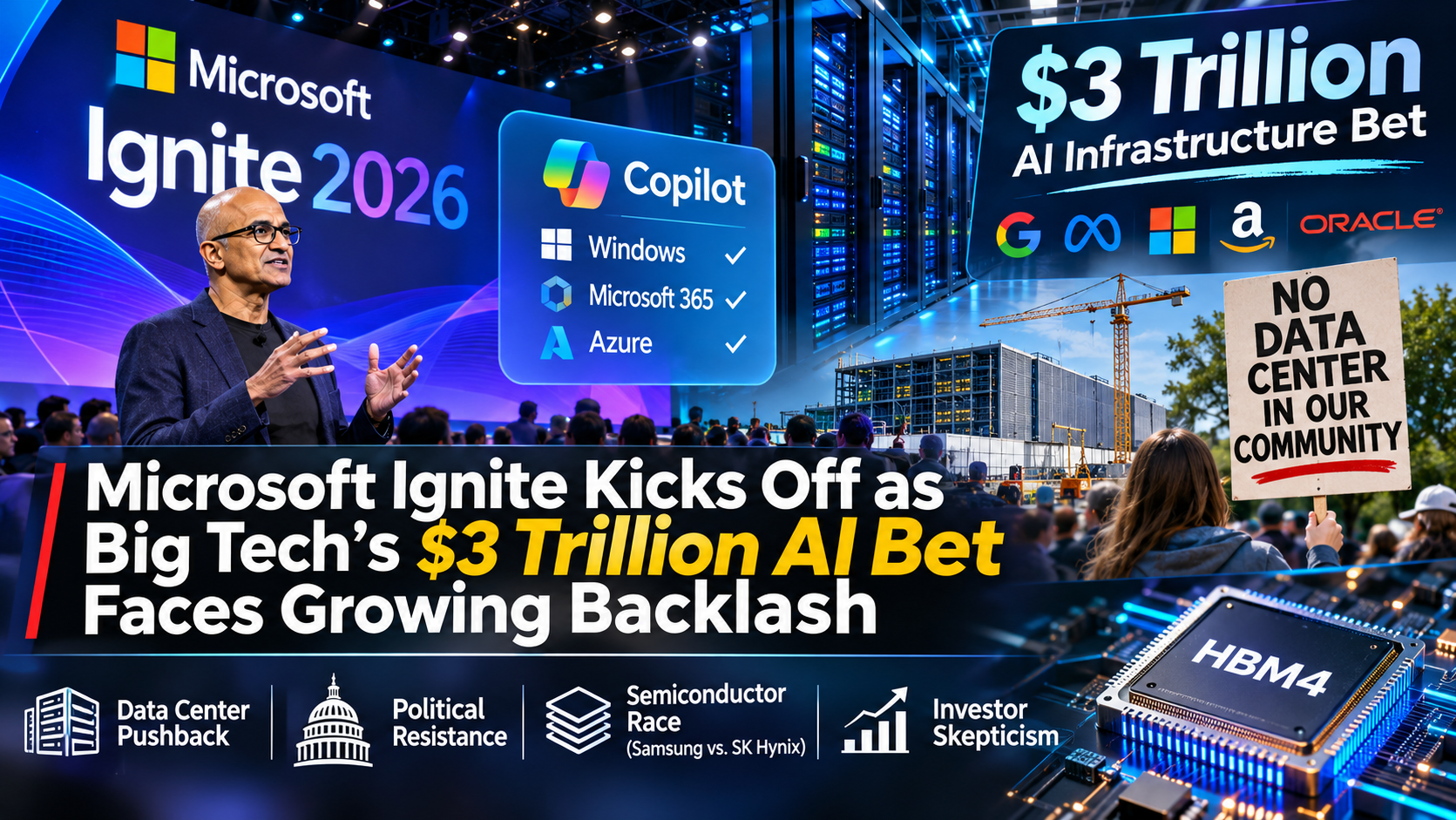
SAN FRANCISCO — Microsoft opens its annual Ignite conference on November 17, with the company expected to showcase its latest Copilot integrations and Azure AI infrastructure at a moment when the broader technology sector is grappling with a $3 trillion spending commitment and growing political resistance to the data centers underpinning it .
The conference, running through November 20, will feature sessions on artificial intelligence, cloud infrastructure, and cybersecurity, with Microsoft Copilot—now embedded across Windows, Microsoft 365, and Azure—expected to be the central focus . The event comes as the industry confronts a paradox: demand for AI compute is surging, but the physical infrastructure required to meet it is facing unprecedented pushback.
The $3 Trillion Bet
Five technology giants—Alphabet, Meta, Microsoft, Amazon, and Oracle—have collectively committed more than $3 trillion to AI infrastructure in the coming years, according to Bloomberg-compiled disclosures . The commitments cover data center construction, energy contracts, equipment purchases, and long-term leases, with Alphabet alone disclosing contractual obligations exceeding $1 trillion, nearly eight times its figure from a year earlier .
Meta's future spending commitments exceed $800 billion, nearly half of which is tied to data center leases that have not yet taken effect, with payment terms stretching up to 30 years . The scale of these obligations has begun to strain free cash flow: Alphabet and Meta have both seen their cash generation turn negative as they fund the buildout, while Oracle became the first major technology company to report negative free cash flow due to AI data center investment .
The spending wave extends beyond the hyperscalers. Hyperscale Data, a smaller AI data center operator, will hold an investor day on November 12 to discuss its Michigan campus, which it says could ultimately support more than 300 megawatts of power capacity . The company has signed a master services agreement with a California-based neocloud provider that could generate more than $3 billion in contract revenue over 20 years if all options are exercised .
Political Headwinds Mount
The infrastructure buildout is colliding with an increasingly hostile political environment. A Quinnipiac University poll conducted in late September found that 73% of Americans oppose AI data center construction in their local communities, compared with 21% in favor . Opposition crosses party lines: 85% of Democratic supporters, 76% of independents, and 55% of Republicans said they opposed local data center projects .
The sentiment has found its way onto the campaign trail ahead of Tuesday's midterm elections. Market analysts cited by Japanese financial outlet Toushiru said investors are increasingly pricing in the possibility that Democratic gains in Congress and statehouses could lead to data center regulation or taxation . New York Governor Kathy Hochul, a Democrat, signed an executive order in July freezing state approvals for large-scale data centers for roughly a year .
The concerns center on electricity prices, water usage, and noise—the classic markers of NIMBY ("Not In My Back Yard") resistance. With 36 governorships up for election this cycle, including seven of the top ten data center states, the regulatory landscape could shift significantly in the coming months .
Semiconductor Supply Chain in Focus
The infrastructure demands are also reshaping the semiconductor industry. Samsung Electronics and SK Hynix are locked in an intensifying competition over HBM4, the sixth-generation high-bandwidth memory chip that powers Nvidia's next-generation AI accelerators, according to Yonhap News .
Samsung said its HBM4 revenue tripled quarter-over-quarter in the third quarter, with HBM4 now accounting for roughly 60% of its total HBM sales . The company claimed it has already achieved its goal of matching its overall DRAM market share in the HBM segment, a significant shift from a year ago when SK Hynix held a 56% share to Samsung's 23% . SK Hynix, meanwhile, has raised its yield targets for HBM4 as it seeks to defend its leadership position .
In Europe, SEMICON Europa opens in Munich on November 10, with advanced packaging and AI-driven manufacturing taking center stage as the continent seeks to strengthen its chip supply chain resilience . The conference will examine heterogeneous integration, chiplets, and hybrid bonding as conventional semiconductor scaling becomes increasingly difficult .
What to Watch
Microsoft's Ignite keynote will be closely watched for signals on how the company plans to monetize its AI investments amid the cash-flow pressure facing the sector. Apple reports earnings on November 2, with analysts focused on whether Apple Intelligence has begun translating into hardware upgrade demand . AMD follows on November 3, with its MI300/MI350 AI chip shipment figures serving as a key indicator of whether Nvidia's dominance faces a credible challenge .
For the technology sector, the coming weeks will test whether the AI infrastructure bet—measured in trillions of dollars and decades-long contracts—can withstand the combined pressure of investor skepticism, political resistance, and the physical limits of power and land.