

U.S. stocks tumbled Thursday as investors dumped chipmakers and other companies tied to the artificial intelligence buildout, wiping out Wednesday's post-election rally in a single session.
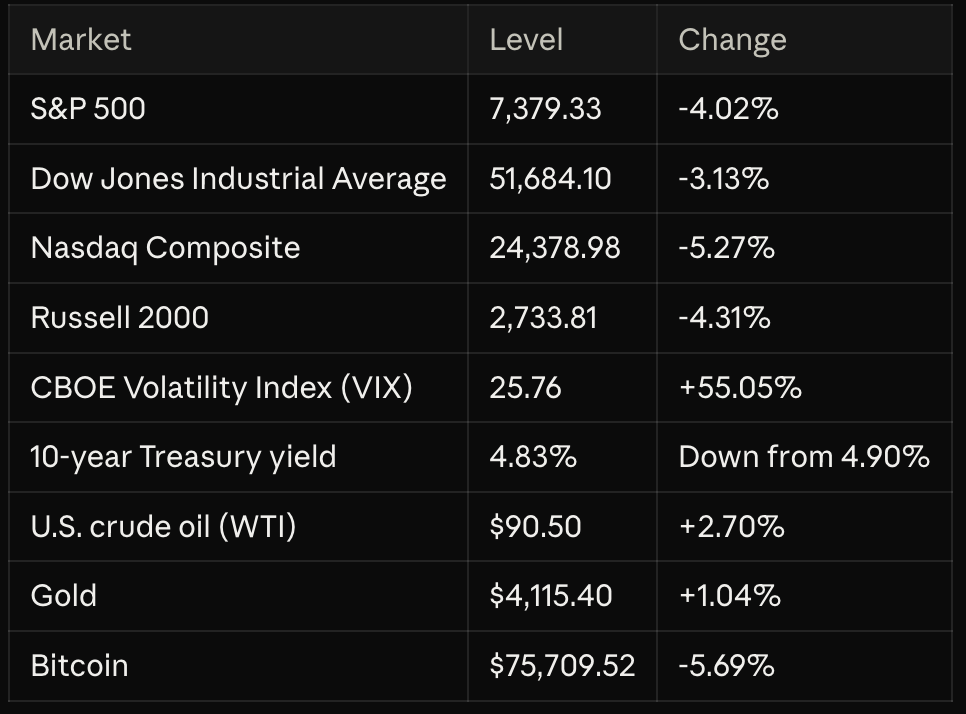
The Nasdaq Composite was down 5.3% at about 1 p.m. ET and on track to close in correction territory, meaning at least 10% below its Oct. 6 record close. The S&P 500 had fallen 4%, while the Dow Jones Industrial Average had dropped about 1,670 points, or 3.1%. The Nasdaq and S&P 500 were on pace for their worst day since the April 2025 "Liberation Day" tariff selloff.
Market snapshot
Why stocks are falling
The selling was centered on AI. The PHLX Semiconductor Index dropped nearly 11%, with Nvidia, Micron and Advanced Micro Devices among the hardest hit. Nvidia was the biggest drag on the S&P 500 because of its size, while AMD lost about 15% and Micron fell about 12%. AI cloud provider CoreWeave and power equipment maker GE Vernova also slid.
Investors are weighing whether Democrats' sweep of both chambers of Congress, including wins in key data center states, could lead to tighter regulation or pauses in data center construction. Any slowdown could mean fewer AI chip orders. The election is not the only pressure, though: AI stocks have been volatile for months on concerns that high borrowing costs could slow new data center projects.
Company news added to the pressure. Qualcomm fell by double digits after its smartphone chip sales missed Wall Street estimates. Tesla and SpaceX each lost more than 9% amid concerns about data center regulation and the prospects for a merger between the two companies.
A sharp reversal
The drop came one day after the Dow surged 1,569 points, or 3%, to 53,356.12. The S&P 500 rose 1.6% that day and the Nasdaq gained 1.4%, as investors welcomed the election's outcome and a slide of more than 8% in crude oil prices.
Thursday's decline put the Dow on course for its worst second session after a midterm election in data going back to 1896, according to Yahoo Finance. Wall Street's fear gauge, the VIX, climbed as much as 65% during the morning.
Beyond the chip selloff
Every S&P 500 sector was lower as of midday, according to the Associated Press, but a few companies bucked the trend. AppLovin jumped about 28% after beating analysts' estimates and expanding its stock buyback program. Coach owner Tapestry gained 6.6% after strong results and a raised forecast.
The economic news was relatively solid. Weekly jobless claims fell, and employers announced 43,994 job cuts in October, down 71% from a year earlier, according to Challenger, Gray & Christmas. Treasury yields eased as well, which may signal that investors are moving toward safer assets.
Overseas, South Korea's Kospi sank 5.3% and Japan's Nikkei 225 lost 1.8%. London's FTSE 100 slipped 0.4% after the Bank of England raised its key interest rate to 4%, its first increase since 2023.
What to watch next
The next major test is Friday's U.S. jobs report for October. Traders currently expect the Federal Reserve to raise rates next month, so strong or weak data could shift those expectations. Investors are also watching for developments in the Iran war, which continues to influence oil prices and inflation, and for any sign of how the new Congress will approach AI and data centers.