
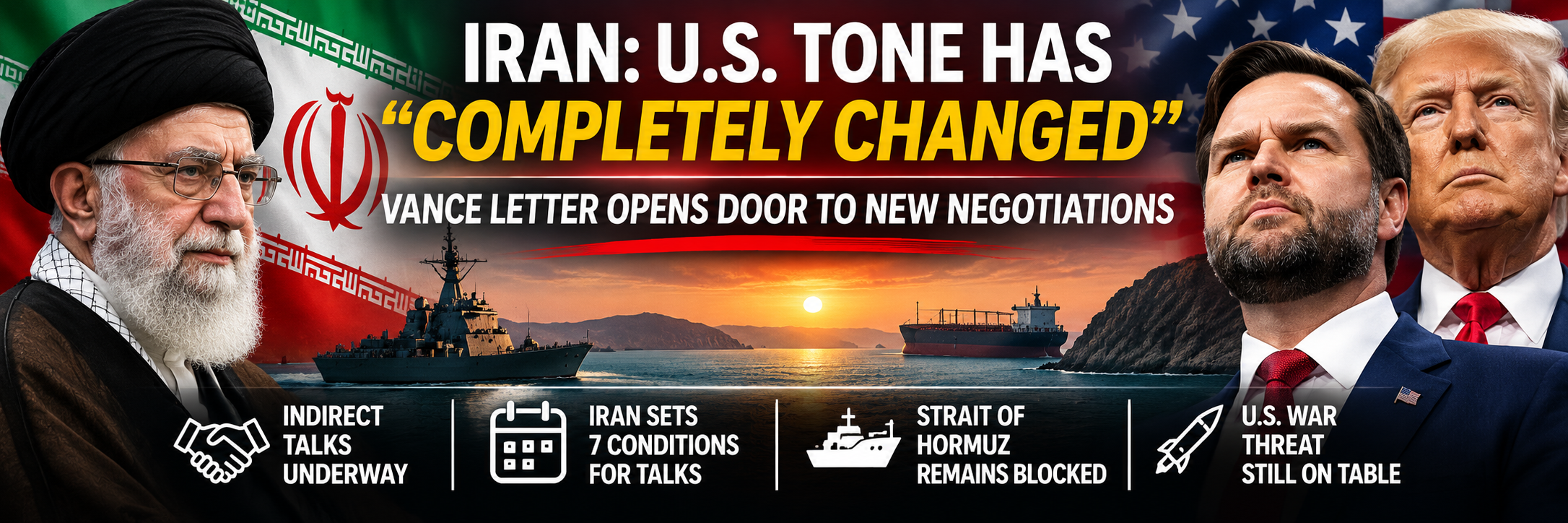
TEHRAN — Iran's top security official said Saturday that the United States has "completely changed" its tone in seeking to restart negotiations, marking Tehran's first on-the-record reaction to a letter from Vice President JD Vance, as indirect talks through Qatari and Pakistani mediators continue without a direct meeting between the two sides.
Mohsen Rezaei, secretary of Iran's Supreme National Security Council, told state broadcaster IRIB that he had read Vance's letter but had not yet responded. "Their tone has completely changed," Rezaei said, calling the shift "a good sign" that showed Iran had "consolidated its victory".
The Vance Letter
The letter, delivered through Qatari mediators, was sent at the direction of President Donald Trump and focuses on a possible framework for negotiations rather than specific peace terms, according to The Wall Street Journal. The New York Times reported it proposed direct talks led by Vance with Iran's nuclear program on the table from the outset.
Trump, speaking to reporters, downplayed his role in the initiative while confirming his approval. "Vance asked me what I thought, and I said, 'If you want to do this, I agree,'" Trump said.
Iran's Conditions and Mediation
Rezaei stressed that Iran insists the United States fulfill seven conditions before any negotiations can proceed, warning that "unless our conditions are met, the Strait of Hormuz will not be opened, and we will not enter into negotiations". He declined to elaborate on the letter's contents, citing American silence on the matter.
Foreign Minister Abbas Araghchi told Al Jazeera that Tehran had studied the letter and described Washington's attempt to open dialogue as a "positive step," but he ruled out direct meetings for now. "We see no need to meet with the Americans at this time," Araghchi said. "Our conditions are clear and the mediators are continuing their consultations". An Iranian delegation is in Doha continuing talks with Qatari and Pakistani mediators.
Araghchi also said mediators had proposed a shortened implementation timeline for Iran's "seven-day plan"—originally a proposal to halt hostilities and reopen the Strait of Hormuz within seven days if conditions are met—with Qatar suggesting five days and Iran now agreeing to two.
Military Threats Loom
The diplomatic maneuvering comes amid heightened military tensions. The Wall Street Journal reported that Washington has told several Gulf Arab countries to prepare for a possible "short, intense military campaign" against Iran after the U.S. midterm elections on November 3, though Trump has not made a final decision.
Rezaei warned that Iran would retaliate more widely against any new attack, saying it could strike U.S.-related infrastructure including data centers and artificial intelligence targets. He also said Iran is debating whether to maintain its longstanding ban on nuclear weapons if hostilities resume, though no decision has been taken.
Araghchi said Iran does not rule out the possibility of war and is prepared for all scenarios, while insisting Tehran "will never surrender" to economic pressure.
The conflict, which the United States and Israel launched in late February, has severely disrupted energy shipments from the Gulf. Iran has blockaded the Strait of Hormuz, through which roughly a fifth of the world's oil and liquefied natural gas once traveled, while the United States maintains a naval blockade of Iranian ports.